Optispan-Apollo
HIPAA-compliant clinical collaboration platform reducing documentation and coordination friction.
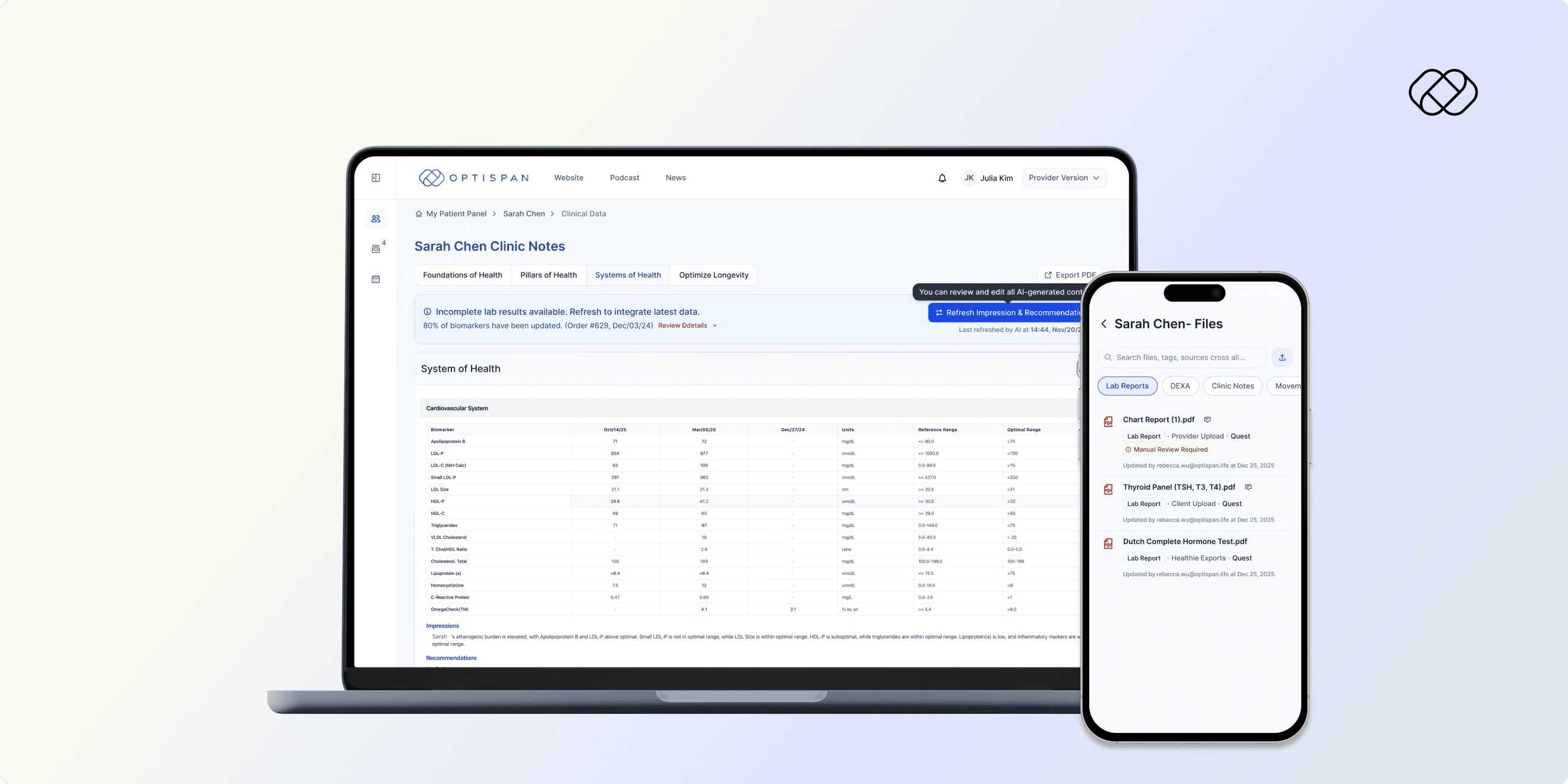
Overview
Optispan is a HIPAA-compliant clinical collaboration platform that helps physicians and clinic staff coordinate care while dramatically reducing documentation burden.
I led 0–1 product design across provider and patient experiences, defining AI-assisted documentation, file ingestion, task and notification systems, and patient profiles; collaborated closely with clinicians and engineering team to establish human-in-the-loop AI workflows and scalable interaction foundations.
Responsibility
Solo Product Designer
Provider and Patient experiences, Desktop + Mobile experience
Focus
Human-in-the-loop AI Workflows, File Ingestion, Tasks/Notifications System
Timeline
2025.6 - 2026.1, 7 months
Collaboration
Project Manager, Product Manager, 5 Engineers, 3 Internal Clinic Users, 3 Customer Users
Impact
90->30 min
Note time reduced
-65% ↓
Manual entry reduced
92%
Customer user satisfaction
Problem - Predesign situation
Fragmented data and tool sprawl break clinical workflows
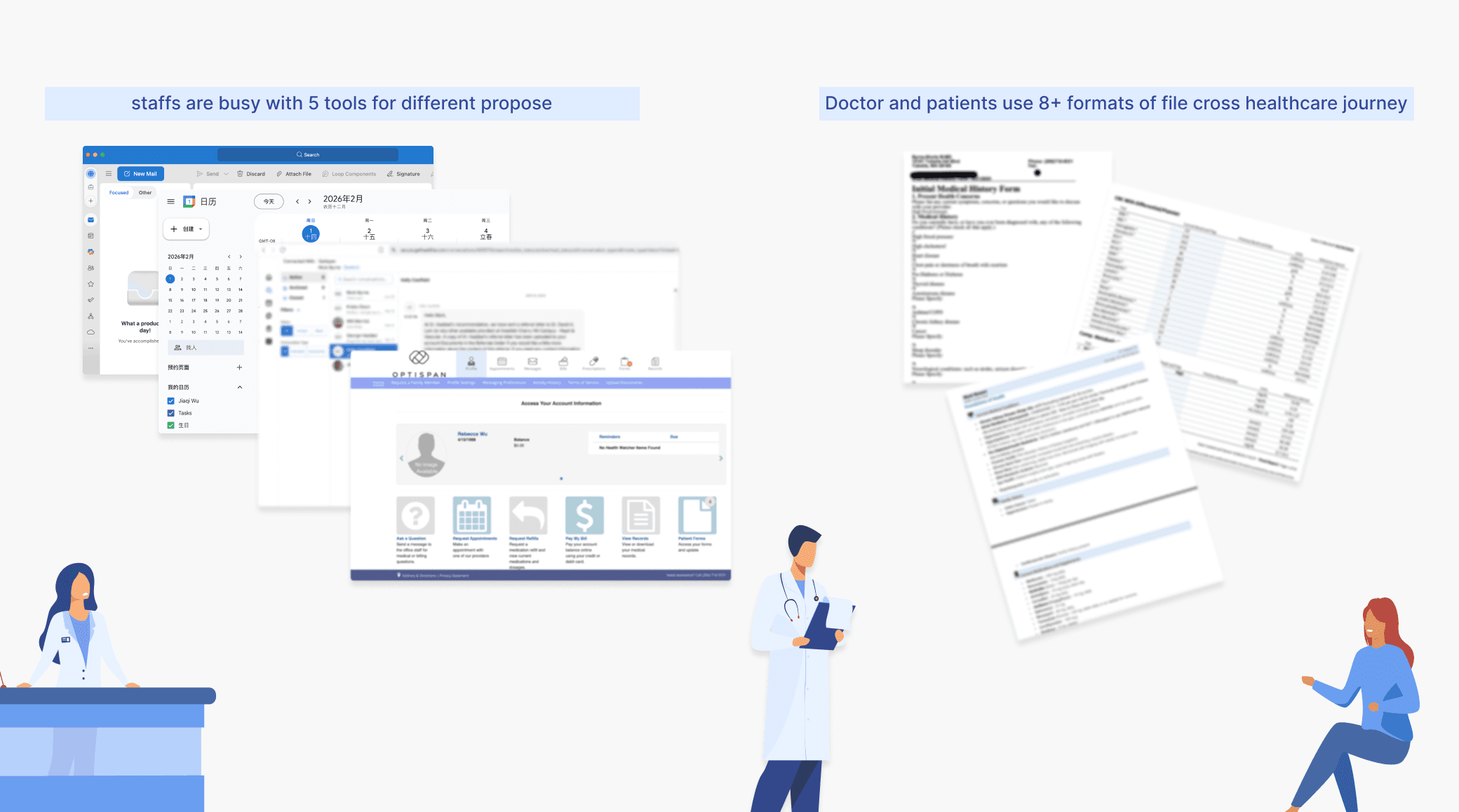
Current System Problem
Image
Fragmented data increases clinical risk
Patient information lived across PDFs, Labs, IoT, and manual entry.
Tool sprawl breaks care coordination
linical work flow cross 5+tools (EHR, ZOOM, phone call, email, Heathie)
Solution Overview
Designed an end-to-end AI-assisted workflow that integrates documentation, data ingestion, and task coordination while preserving human control and auditability.
SOLUTION highlight/1
A user-owned data foundation from files to clinical context
I identify the friction in backend-supported file handling workflows and proposed a user-facing file system, treating documents as first-class objects with visible AI-generated tags, and review states.
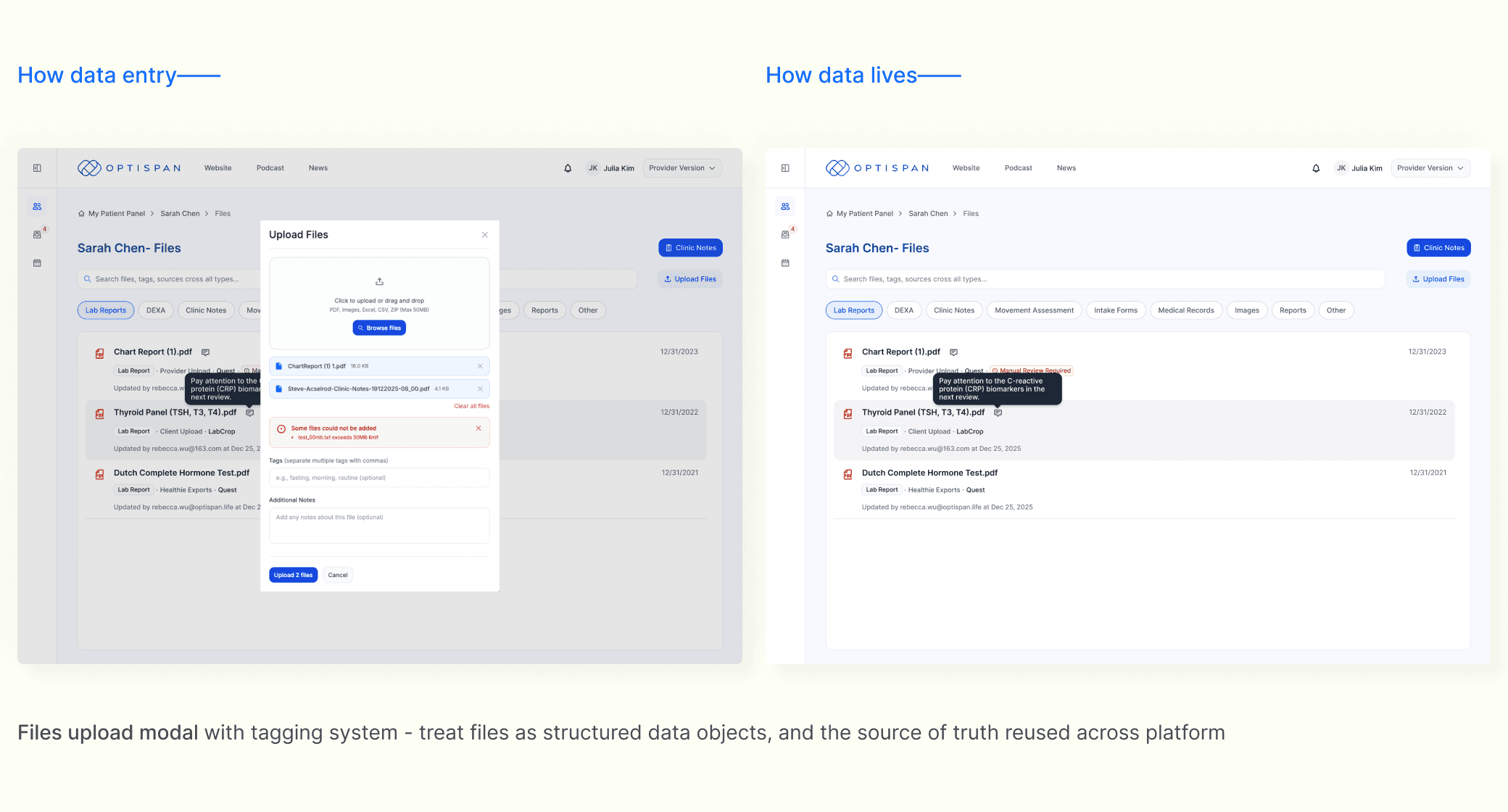
Feature: File Upload
Image
I structured data from uploaded files powered an 80+ biomarker dashboard and served as a shared foundation for both clinic decision making and AI-assisted documentation.
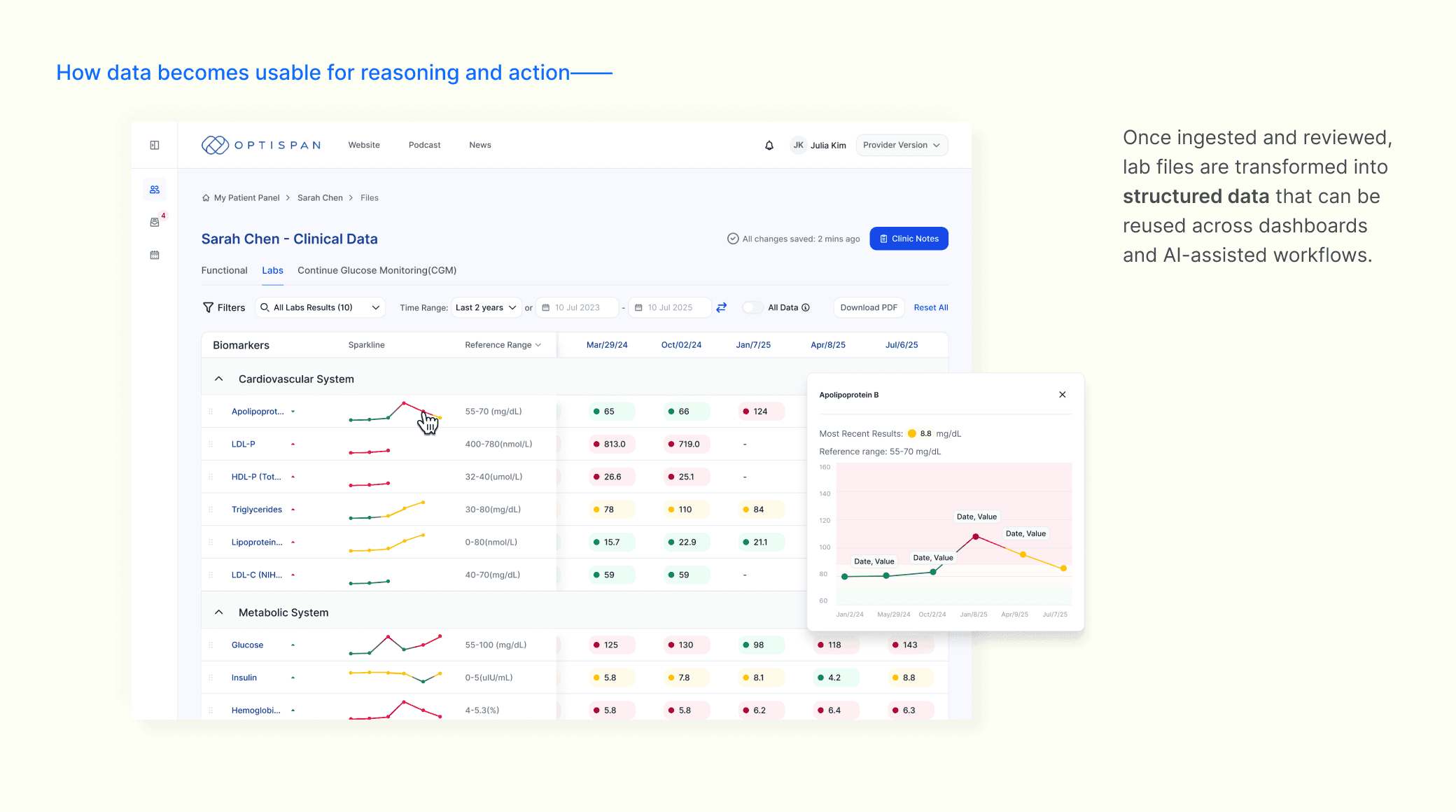
Feature: Clinic Data-Labs
Image
SOLUTION highlight/2
Explicit human-in-the-loop boundaries for clinical AI
With structured data as the foundation, I positioned a Clinic AI copilot as a collaborative layer in documentation rather than a decision-maker. By defining explicit human-in-the-loop boundaries and review states, clinicians retained control and accountability while benefiting from meaningful efficiency gains.
AI-generated Clinic Note flow with human-in-loop
Demo
SOLUTION highlight/3
State-driven task governance across Clinic and Patient Portals
As the platform scaled in real clinic workflows, coordination between clinic staff and patients became a reliability risk.
I mapped cross-portal transition points and established a shared lifecycle model to clarify ownership, timing, and escalation.
Working with clinicians and engineering, we centralized task governance across portals, increasing completion rates to 80% and reducing care-stage friction.
End-to-End State Synchronization Across Portals
When a clinic assigns a task, the state transition instantly to the patient portal and updates clinic dashboards upon completion. Both portals operate on a single source of truth.
An end-to-end task synchronization across portals
Demo
From Isolated Feature to Lifecycle Governance
Rather than designing tasks and reminders as isolated features, I defined a task lifecycle model shared across portals. All state mutations flow through structured governance rules, ensuring synchronization, visibility, and accountability.
Task lifecycle model shared across portals
Diagram Motion
Key iterations
Iteration 1: Human-Initiated AI Refresh
The initial system automatically regenerated clinical notes as data arrived, creating false confidence and eroding clinician trust——Trust break because the system acted without clinician intent.
Design Reframe ——
By mapping human and data touchpoint across the clinical workflow, I reframed the problem from “How can we use AI?” to “How should AI act under human intent?”
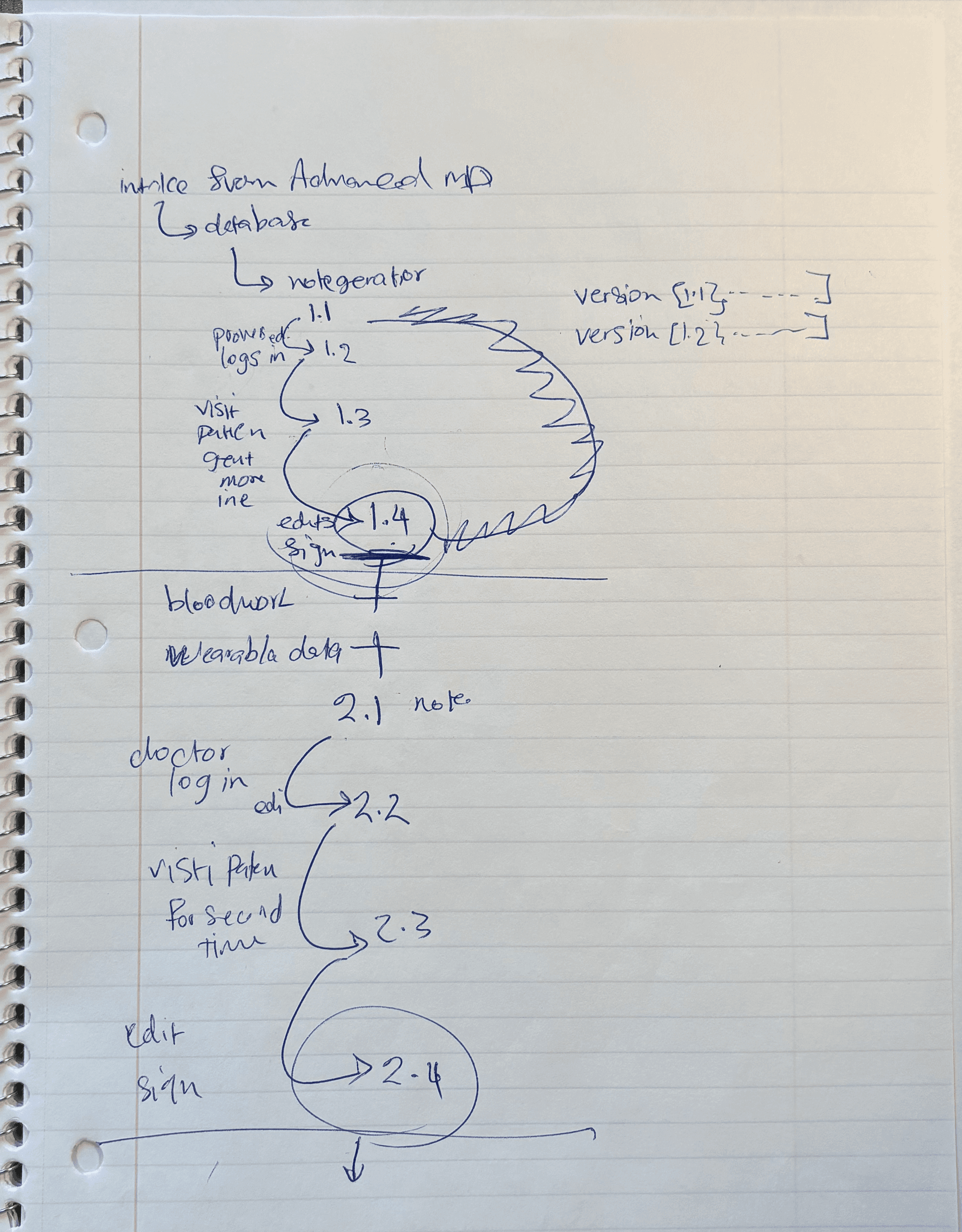
Diagram:Data Arrival Impact Map
Image
Key Design Shift
Through iterative mapping, I aligned design, data, and engineering around a shared principle: AI should act only under human intent.
The system supports this through readiness signals—such as data completeness and key data availability—helping clinicians judge when AI assistance is appropriate.
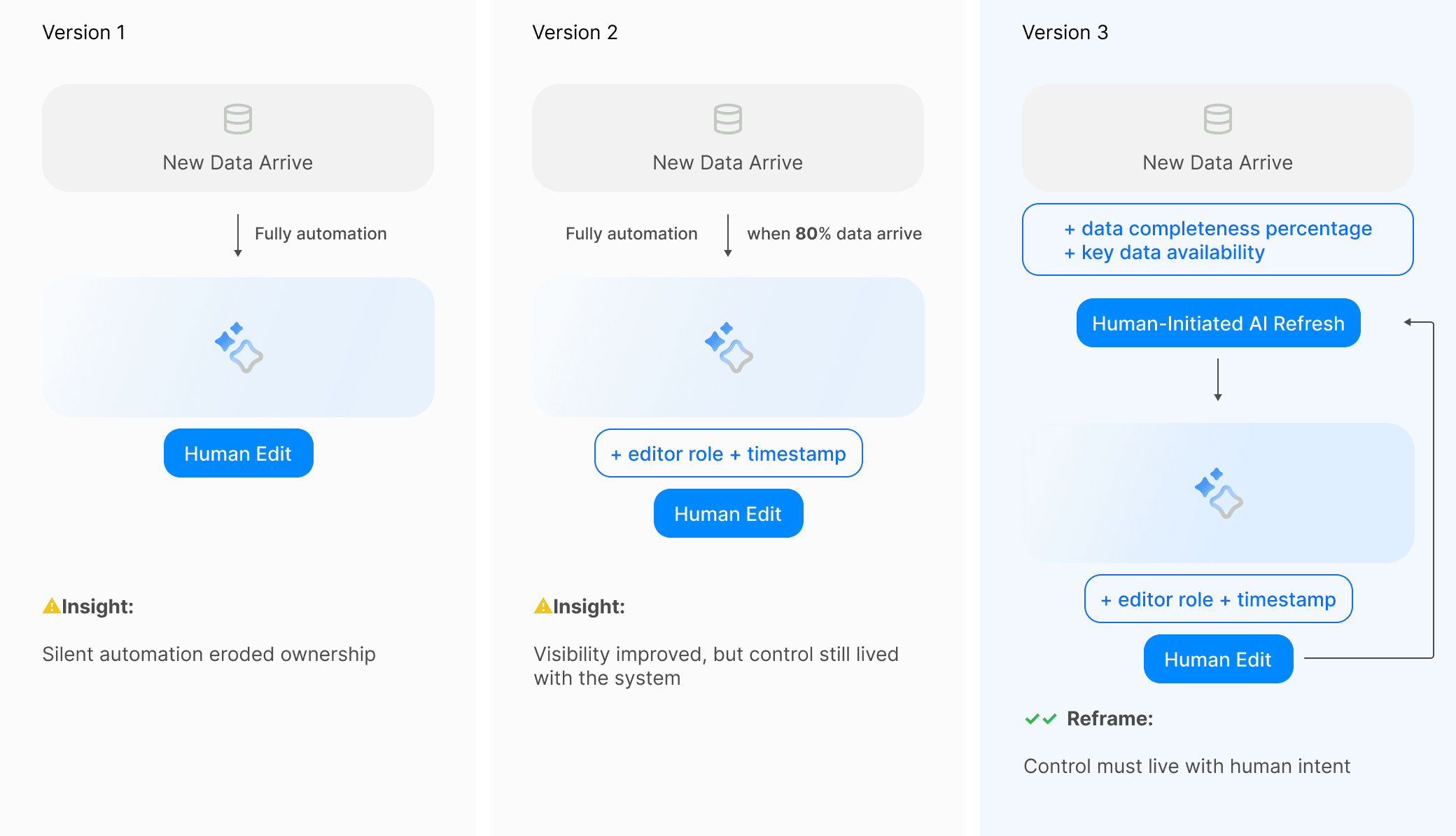
Key Design Iteration: From System-Driven to Human-Intent–Driven AI
Diagram
The final experience reflects this shift through lightweight AI update notifications. Clinicians are informed when new data is available, while remaining in control of if and when AI updates occur.
Final Experience: Human-Initiated AI Refresh
Demo
Iteration 2: AI Ingestion Fallback & Recovery
AI-assisted tagging was introduced to scale file ingestion and support downstream automation.It's a low-risk but high-volume AI surface.
Design Exploration - Three Upload Models
We explored three models and trade-offs between scalability, reliability, and operational clarity. Finally we choose the full-AI Tagging.
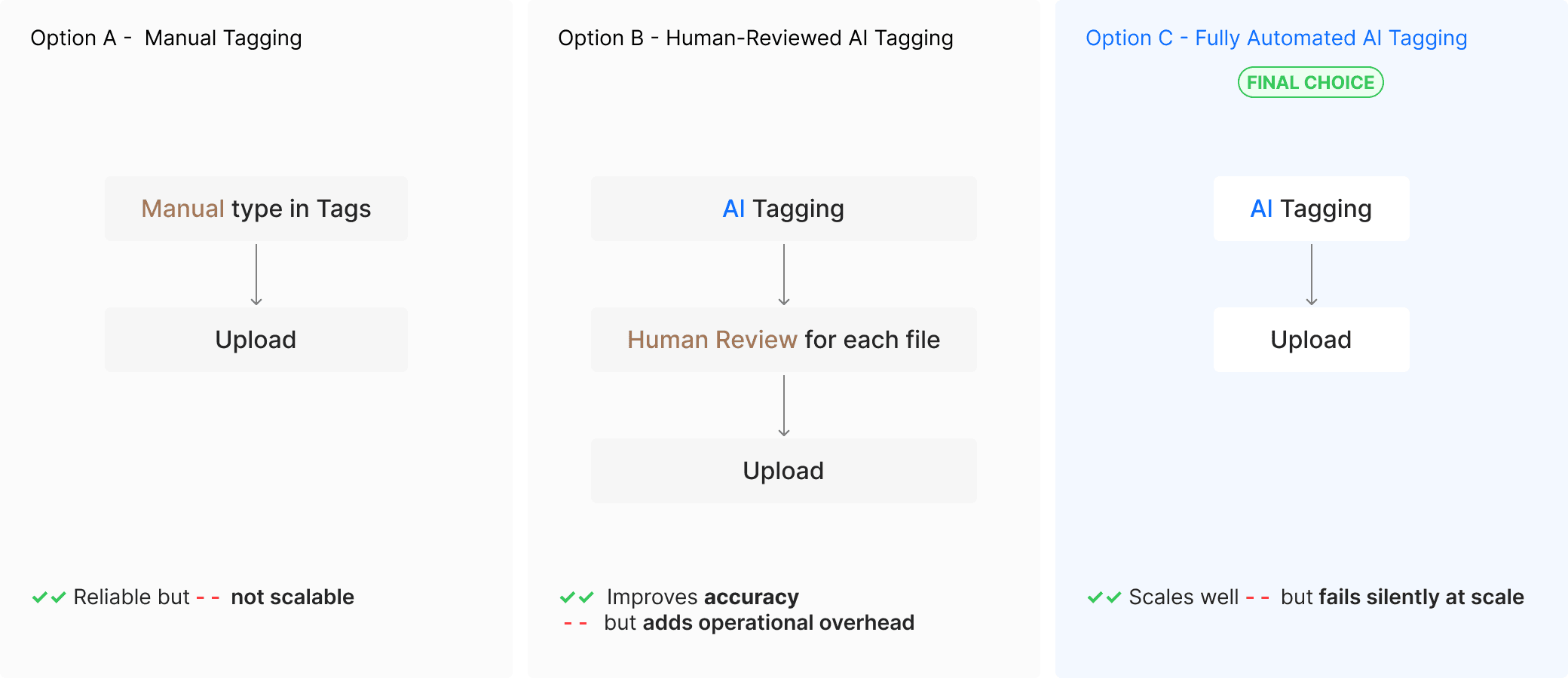
AI Ingestion Models — Design Exploration
Diagram
Key Design Decision & Iteration: AI-Gated Ingestion with Recovery
While full AI automation improved ingestion efficiency, it exposed a system-level risk: file-level failures could block entire uploads. By analyzing edge cases and collaborating with engineering, I redesigned ingestion into an AI-gated model with partial success, file-level recovery, and clear status visibility.
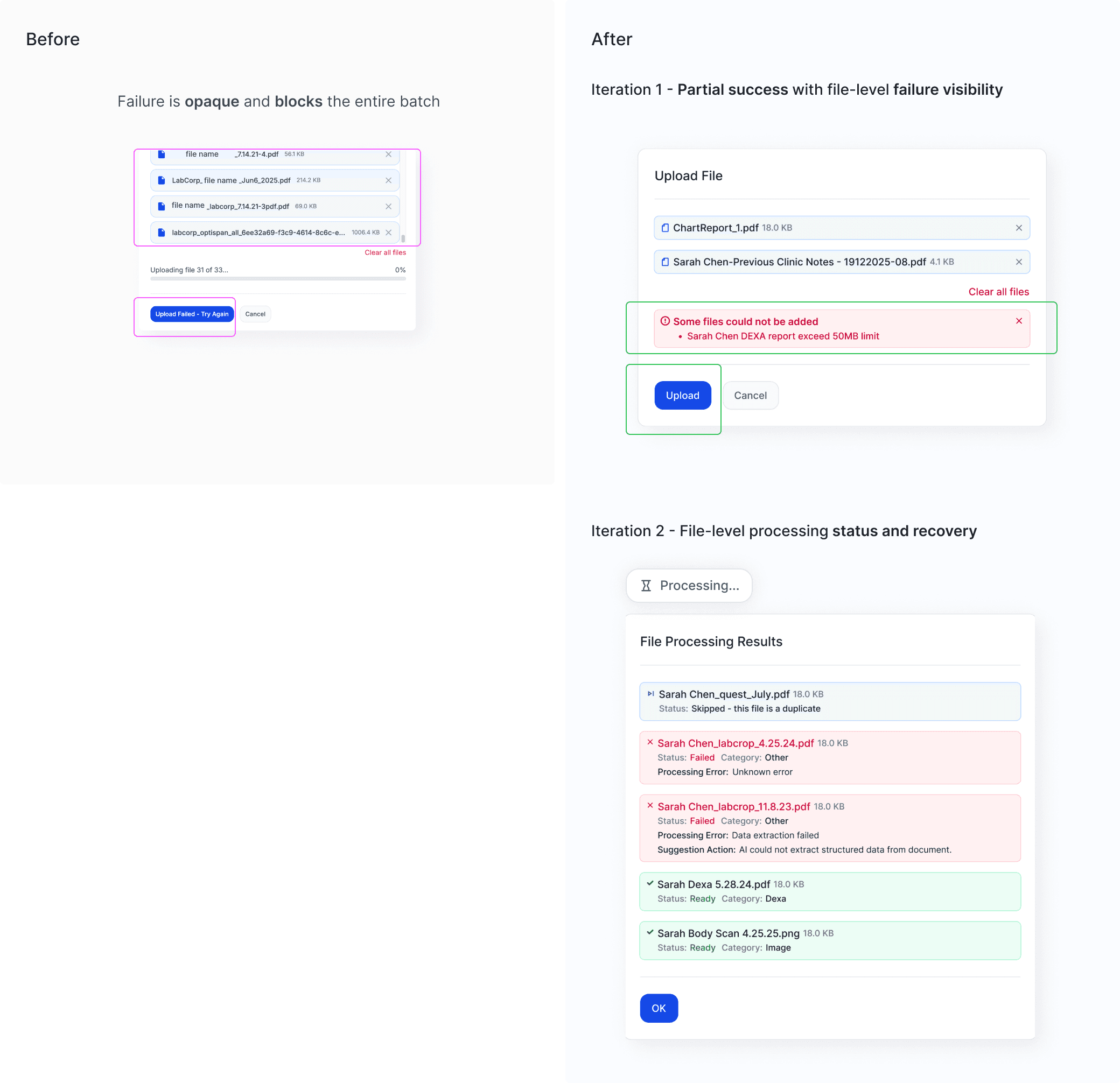
Key Design Decision: From Batch Blocking to File-Level Recovery
Image
The system allows users to proceed despite AI failures. Failed files are isolated and surfaced later, enabling recovery route.
Final Outcome: Recovery-First Ingestion at Scale
Demo
Retrospective
Lessons / Next step
My next step includes:
Scale validation across contexts and surfaces to real patient journeys and mobile touchpoints. Evolve clinician-first patterns into consumer-friendly experiences, reducing cognitive load.
Formalize interaction patterns into a scalable design foundation, to support faster iteration and consistency cross 2 user portals.
lesson 1 - AI interaction design
Trust in AI systems is shaped more by how uncertainty and control are expressed in the interface than by model accuracy alone.
lesson 2 - Data & system design
Design data as a shared interaction layer, made it possible to support visualization, AI reasoning, and task workflows without duplicating complexity.